
The problem? Every classification society — BV, DNV, ABS, Lloyd's, RINA, and more — publishes its own notation system. A vessel classed DYNAPOS AM/AT R by Bureau Veritas and one classed DPS 2 by NMD are exactly equivalent. But that's not obvious from the notation alone — and in a chartering context, that confusion has real operational and contractual consequences.
The foundation: IMO MSC/Circ.645
All DP notations ultimately reference three IMO equipment classes, defined in IMO MSC/Circ.645 — Guidelines for vessels with dynamic positioning systems. Whatever the classification society, whatever the flag state, the underlying safety standard is the same.
The classification society notation is, in essence, their own branded label for the same tiered framework.
The three IMO equipment classes explained
Class 1 — Single system, basic redundancy
Loss of position may occur in the event of a single failure. There is no requirement for redundancy of active components. Class 1 is appropriate for operations where a drift-off would not cause catastrophic consequences — anchor-handling, supply runs, standby duty, and certain towing operations.
Class 2 — Redundant systems, no single failure
No single failure in an active component or system shall cause the vessel to lose position. Redundancy is built into power, thruster, and DP computer systems. Class 2 is the industry standard for most offshore energy operations — including subsea intervention, diving support vessel (DSV) operations, and FPSO tender work.
Class 3 — Redundant + physically separated systems
Same requirements as Class 2, plus the redundant systems must be physically separated — meaning a fire or flood event in one compartment cannot disable both systems simultaneously. Class 3 is mandatory for the most safety-critical operations: work near live wellheads, operations over flexible risers, and certain saturation diving missions.
Practical rule of thumb: If loss of position could cause a blowout, a riser disconnect, or a diver fatality — you need DP 3. If it could cause property damage or operational delay — DP 2. If the consequences are manageable — DP 1 is sufficient.
Cross-registry equivalence: the full mapping
This is where most practitioners struggle. Here is the complete cross-reference across all major classification societies, sourced from IMO MSC/Circ.645 and society-specific guidelines.
IMO Class | BV | DNV | ABS | GL | LR | NK | RINA | RS | NMD | KR |
|---|---|---|---|---|---|---|---|---|---|---|
Class 0 | DYNAPOS SAM | DYNAPOS AUTS | DPS 0 | DPS-0 | DP (CM) | — | DYNAPOS SAM | — | DPS 0 | — |
Class 1 | DYNAPOS AM/AT | DYNAPOS AUT | DPS 1 | DPS-1 | DP 1 / DP (AM) | Class A DP / DPS A | DYNAPOS AM/AT | IPD-1 / DYNPOS-1 | DPS 1 | DPS (1) |
Class 2 | DYNAPOS AM/AT R | DYNAPOS AUTR | DPS 2 | DPS-2 | DP 2 / DP (AA) | Class B DP / DPS B | DYNAPOS AM/AT R | IPD-2 / DYNPOS-2 | DPS 2 | DPS (2) |
Class 3 | DYNAPOS AM/AT RS | DYNAPOS AUTRO | DPS 3 | DPS-3 | DP 3 / DP (AAA) | Class C DP / DPS C | DYNAPOS AM/AT RS | IPD-3 / DYNPOS-3 | DPS 3 | DPS (3) |
Quick memory aid by society:
BV → DYNAPOS prefix, suffix encodes redundancy (none / R / RS)
DNV → DYNAPOS prefix, suffix encodes redundancy (AUT / AUTR / AUTRO)
ABS / GL / NMD / KR → DPS numeric scale (0–3)
LR → DP numeric (1–3) or DP + letter code (AM / AA / AAA)
NK → Class A / B / C or DPS A / B / C
RS → IPD numeric or DYNPOS numeric
Decoding Bureau Veritas notation in depth
BV is the most widely used registry for European offshore tonnage, and its DYNAPOS notation is worth understanding in full.
AM/AT — the core DP designation
AM = Automatic Mode — the vessel can maintain position automatically using its DP system
AT = Automatic Track — the vessel can follow a predefined route automatically
Together, AM/AT confirms that the vessel has a fully operational DP system capable of both station-keeping and track-following.
The R suffix — redundancy (Class 2)
Adding R elevates the notation to Class 2. This means no single failure of an active component — a thruster, a generator, a DP computer — can cause loss of position. The system architecture must be fully redundant.
The RS suffix — redundancy + separation (Class 3)
Adding RS elevates to Class 3. The R requirement stands, and additionally, redundant systems must be physically separated by A-60 fire-rated divisions or equivalent, ensuring that a single casualty event (fire, flooding) cannot take out both redundant legs simultaneously.
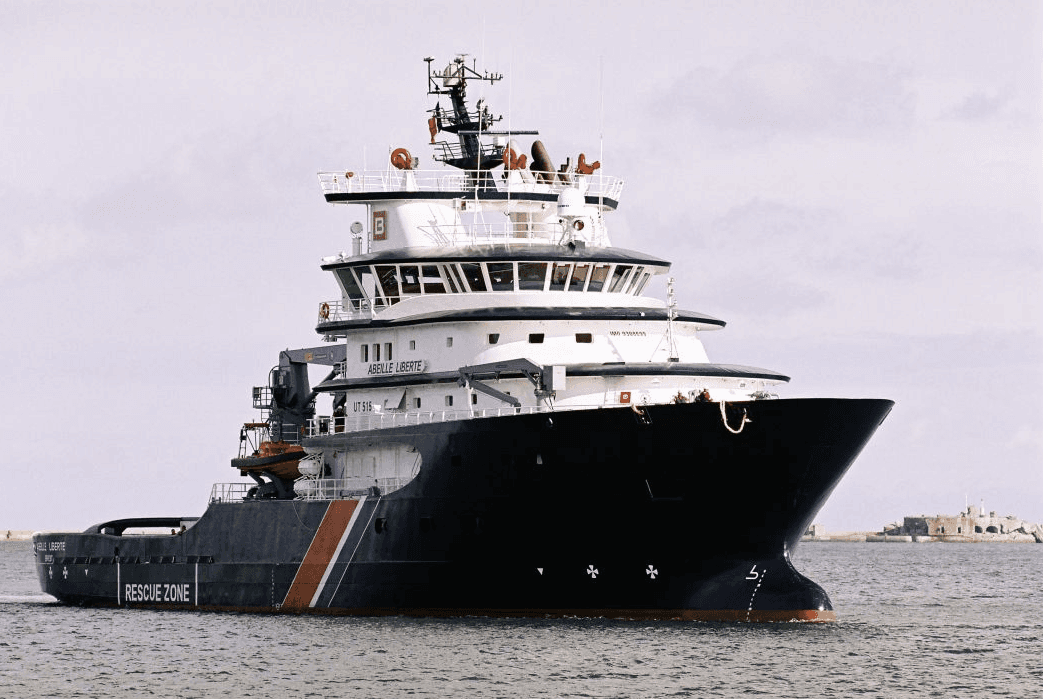
Vessel spotlight: Abeille Liberté
The Abeille Liberté is a French emergency response and salvage tug operating primarily on the Atlantic coast and in the Mediterranean under contract with the French State. Her full BV class notation is a perfect illustration of how classification layering works in practice.
Full class notation:BV I HULL, MACH | Salvage Tug | Unrestricted Navigation | AUT-UMS | Fire Fighting Ship 2 | DYNAPOS AM/AT
Breaking it down
BV I HULL, MACH — Bureau Veritas highest structural and machinery class. The Roman numeral I (first class) indicates full compliance with BV construction rules for both hull integrity and propulsion/auxiliary machinery. This is the top tier.
Salvage Tug — Operational notation confirming the vessel meets BV requirements for salvage operations: structural reinforcement, towing equipment, emergency response systems.
Unrestricted Navigation — The vessel is certified to operate in any sea area worldwide, with no geographic restriction. This is the highest navigation notation.
AUT-UMS — Automated, Unattended Machinery Space. The vessel's engine room can operate without continuous watch-keeping — machinery monitoring and alarm systems meet the standard for periodic unattended operation. This enables reduced crew requirements at sea.
Fire Fighting Ship 2 — The vessel is equipped for active firefighting operations at a minimum capacity of 2,400 m³/h of monitor water delivery. This is a significant operational capability for emergency response in port or offshore.
DYNAPOS AM/AT — IMO Class 1. The Abeille Liberté has full DP capability — automatic station-keeping and track-following — but without the R or RS redundancy suffix. For a salvage tug whose primary mission is emergency towing and response (not subsea operations near wellheads), Class 1 is operationally appropriate and proportionate.
Why Class 1 is the right call here
A salvage tug's operational profile is fundamentally different from a construction or diving support vessel. The Abeille Liberté is not positioning over a live wellhead — she is responding to casualties, connecting towlines in heavy weather, and standing by distressed vessels. In that context, DP Class 1 provides the positioning precision needed without the structural and engineering complexity of a Class 2 or 3 build.
The AUT-UMS notation adds operational flexibility. The Fire Fighting Ship 2 rating adds emergency response capability. Together, the notation tells you exactly what this vessel is built for.
What DP class means in practice for chartering
When evaluating vessels for a specific offshore operation, DP class directly determines:
Marine warranty requirements — Most oil major lifting manuals and marine warranty surveys specify minimum DP class per operation type
Insurance conditions — Underwriters tie premiums and coverage to DP class relative to the operation being performed
Contractual liability — Operating a vessel below the required DP class for an operation can void coverage and create unlimited operator liability
Crew certification — IMCA and NI DP Operator competence requirements are also tied to the vessel's DP class
For operations near subsea infrastructure, FPSO mooring systems, or live risers, DP 2 is typically the baseline. Operations involving crane lifts over wellheads or work in close proximity to flexible risers often mandate DP 3. Simpler anchor-handling, supply runs, or standby operations may be safely performed with DP 1 vessels — at significantly lower day rates.
Understanding the cross-registry equivalence table is what allows charterers and operators to compare vessels across different flag states and classification societies on a true like-for-like basis.
Sources
Capt. D. Bray FNI — DP Operator's Handbook, The Nautical Institute, 2010
IMO MSC/Circ.645 — Guidelines for vessels with dynamic positioning systems
Bureau Veritas, Det Norske Veritas, ABS, Lloyd's Register — Classification society rules
Seavium references 30,000+ offshore and specialized vessels across 200+ companies in 25+ countries — with DP class, registry notation, and operational parameters fully searchable. Explore the platform at go.seavium.com.