
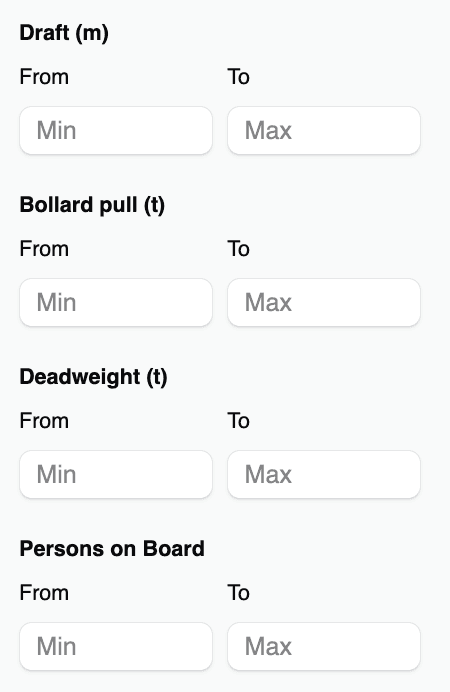
Today, Seavium introduces a new feature:
Filter vessels by POB / PAX MAX directly in the search engine.
This article explains why personnel capacity is a strategic parameter in offshore projects, how it has traditionally been handled, and how this new filter changes the way vessels are shortlisted.
Why POB Matters in Offshore Operations
POB — Persons On Board — is not a secondary technical detail.
In many offshore projects, personnel capacity directly impacts:
Project feasibility
Number of rotations required
Logistics costs
Safety and compliance
Daily operational efficiency
Typical use cases where POB is critical:
Wind farm installation campaigns
Cable laying and inspection projects
Construction support vessels
ROV and survey operations
Accommodation vessels
Offshore maintenance campaigns
Choosing a vessel with insufficient POB can:
Multiply crew transfers
Increase helicopter usage
Create safety constraints
Delay operations
Inflate project costs
POB is therefore not only a comfort issue.
It is a core operational parameter.
How POB Is Traditionally Handled
Despite its importance, POB is still poorly structured in many vessel databases.
Typical workflow today:
Identify candidate vessels by type, DP, deck, etc.
Open each technical specification manually
Search for “PAX”, “POB”, “Accommodation”, or “Berths”
Compare values one by one
Build shortlists manually
This approach has three main limitations.
1. POB data is not standardized
Depending on documents, the same information can appear as:
POB
PAX
Berths
Accommodation
Max persons
This makes automated filtering difficult.
2. Manual comparison is slow
When shortlisting tens or hundreds of vessels, checking POB manually becomes a bottleneck.
3. Risk of mismatches
Misinterpreting accommodation limits can lead to:
Underestimating required capacity
Selecting non-compliant vessels
Discovering issues too late in the process
The Seavium Approach: POB / PAX MAX as a Search Filter
With this new feature, Seavium introduces a dedicated POB / PAX MAX filter in the search engine.
Users can now:
Define a minimum required POB
Instantly filter vessels that meet this capacity
Combine POB with other technical criteria
(DP class, deck area, crane, year, flag, class, etc.)
Instead of reading hundreds of specifications,
you directly search for vessels that can carry your team.
What Changes in Practice
Faster Shortlisting
In projects where personnel capacity is a hard constraint,
POB becomes a first-level filter.
This allows:
Faster elimination of non-compliant vessels
Shorter shortlists
Quicker technical screening
Better Project Feasibility Analysis
By combining:
Required POB
Transit time
Campaign duration
Teams can now better evaluate:
Rotation strategies
Number of crew changes
Logistic complexity
Reduced Operational Risk
Filtering by POB reduces the risk of:
Selecting vessels with insufficient accommodation
Late operational adjustments
Contractual surprises after award
Who Benefits from the POB Filter?
For Charterers
Faster vessel selection
Better alignment with project staffing plans
Reduced logistic uncertainty
More reliable tender responses
For Brokers
More accurate shortlists
Less manual checking
Better matching between client needs and vessel capabilities
For Owners
Better visibility for high-POB vessels
More relevant exposure in tenders
Fewer mismatched enquiries
From Technical Data to Operational Intelligence
Like many features released recently, the POB filter reflects a broader strategy.
Seavium is not only structuring vessel data.
It is structuring operational decision-making.
By turning critical constraints into searchable filters,
Seavium helps users move:
From document reading
To data-driven vessel selection
Search becomes project-driven, not only vessel-driven.
Conclusion
In offshore chartering, personnel capacity is often the hidden constraint that defines the entire logistics chain.
By introducing the POB / PAX MAX filter, Seavium allows users to:
Shortlist faster
Reduce risk
Improve project feasibility
Save time at every tender
This is a simple filter.
But for many projects, it is a decisive one.
Have a look on Seavium: go.seavium.com
If you want to see this feature in action or discuss your next project, you can book a demo here:
https://calendly.com/adrien-seavium/30min
Keywords for SEO:
POB offshore, PAX max vessel, offshore accommodation capacity, vessel personnel capacity, offshore chartering, crew logistics, offshore vessel search, fleet management