
Introduction
In offshore chartering, the real work often starts after the search.
Technical specifications, PDFs, scattered documents — reviewing and cross-checking them manually is time-consuming and error-prone.
At Seavium, we are addressing this problem directly.
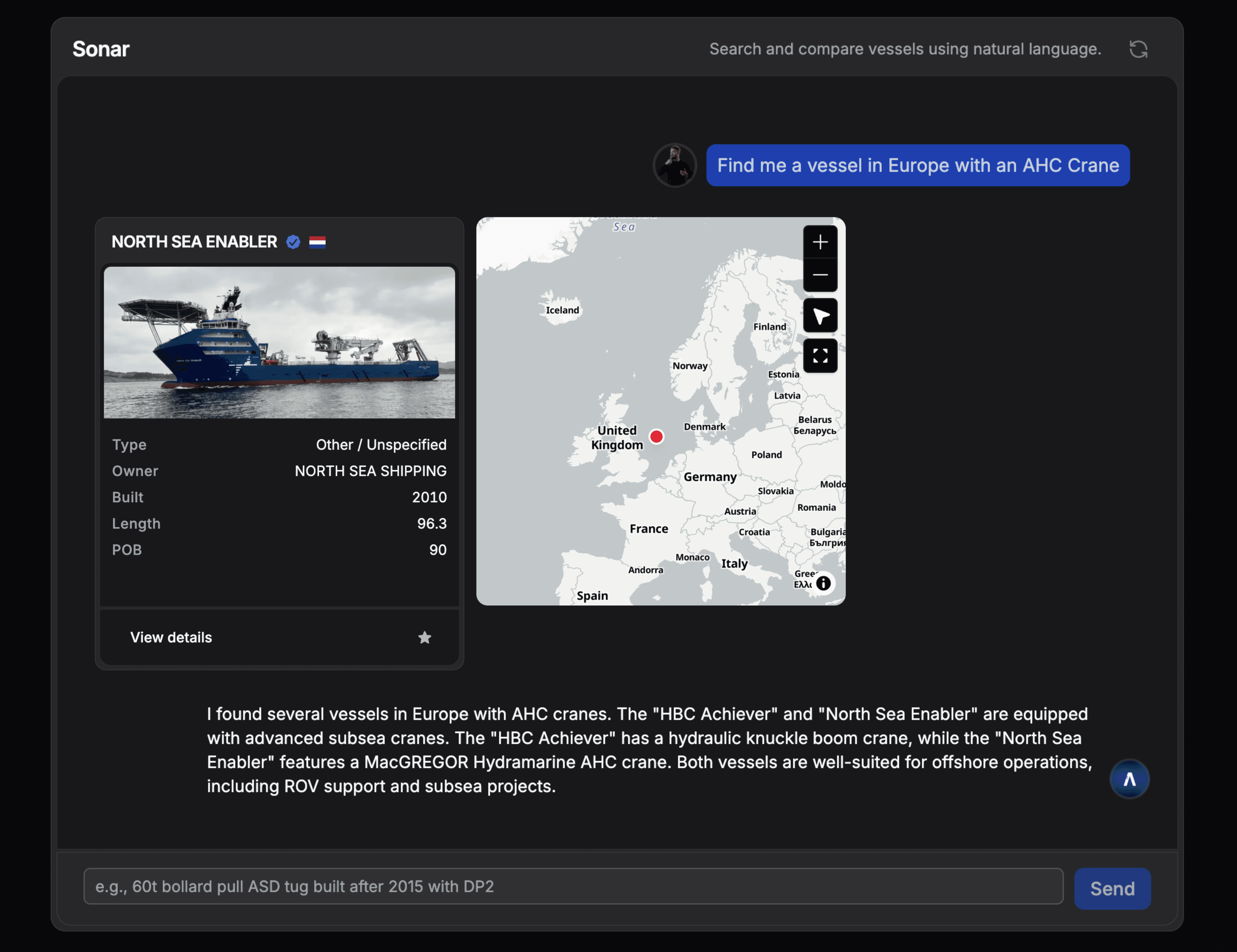
This week, we deployed a major upgrade to Sonar, enabling it not only to understand natural language queries, but also to read and analyze vessel technical specification documents.
Beyond natural language understanding
Natural language understanding is a prerequisite — not the end goal.
Sonar now combines:
improved intent detection from user queries,
with direct access to technical data embedded in vessel specifications.
Instead of relying solely on structured fields, Sonar extracts information from the documents themselves.
Parsing real offshore vessel specifications
Sonar is currently tested on approximately 400 vessel technical sheets.
Using document parsing and embedding-based representations, Sonar can:
identify relevant technical attributes,
contextualize them within an offshore operation,
and match them against real chartering requirements.
This dramatically reduces the need for manual document review.
The technical approach
Without going into unnecessary complexity, this upgrade relies on:
document parsing pipelines,
semantic embeddings,
large language models capable of contextual reasoning.
The objective is not automation for automation’s sake, but time saved on high-friction tasks.
Operational impact
For offshore professionals, this means:
faster vessel screening,
more reliable shortlists,
fewer missed constraints hidden in PDFs.
What used to take hours can now be handled in minutes.
What comes next
This capability is foundational.
It enables upcoming features such as:
geographic reasoning,
deeper operational context awareness,
and progressively more autonomous assistance.
Conclusion
Offshore chartering is document-heavy by nature.
By enabling Sonar to read and reason over vessel technical specifications, Seavium takes a concrete step toward AI that actually saves time in real operations.
👉 Discover Sonar: https://go.seavium.com