
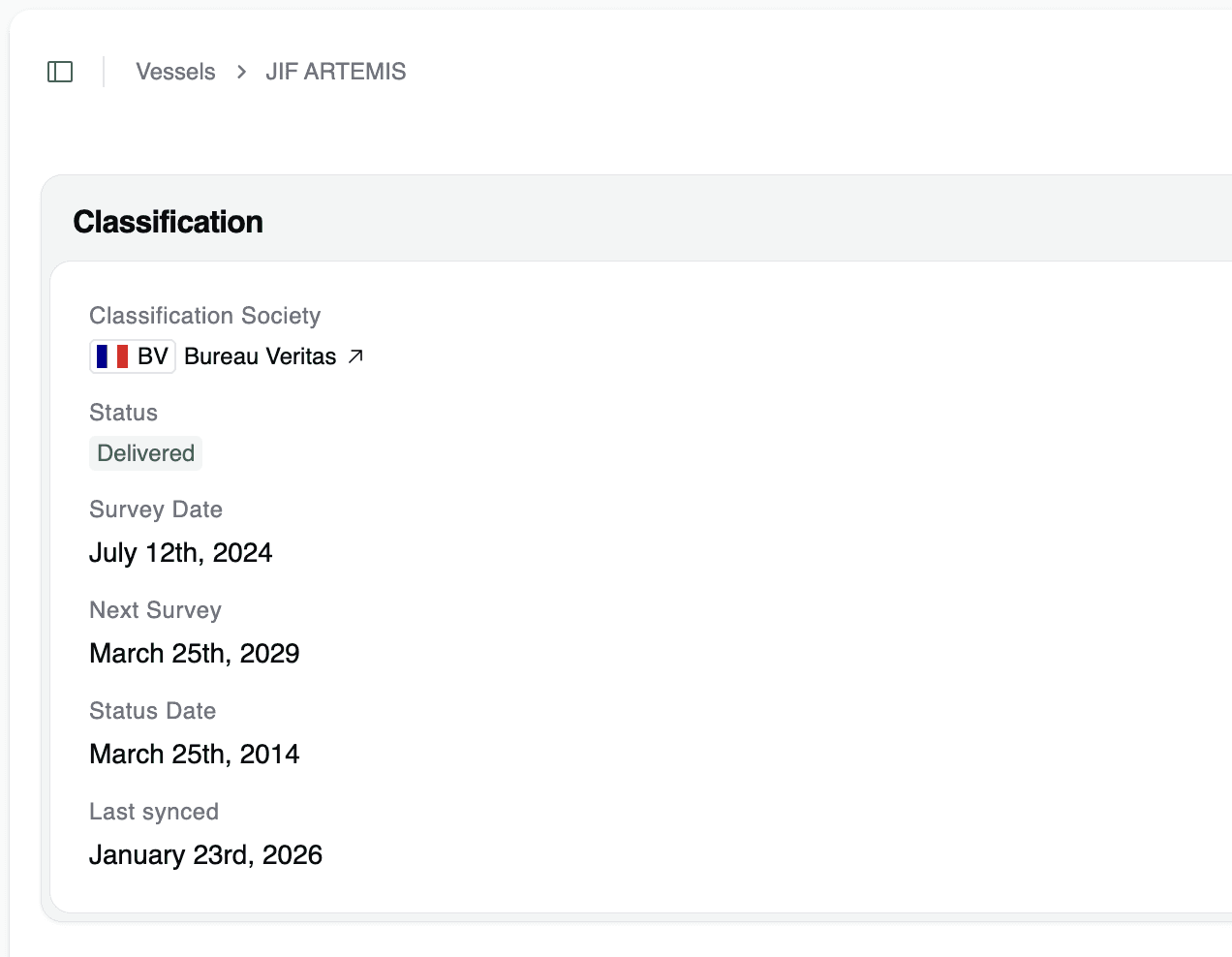
Today, Seavium introduces a new feature:
Real-time IACS Class Status, directly available on each vessel page.
This article explains why this matters, how the industry traditionally handled class verification, and how real-time class data is changing the way offshore chartering is done.
Why Class Status Matters in Offshore Operations
In offshore projects, class is not an administrative detail.
It is a contractual, technical and financial cornerstone.
Class status directly impacts:
Vessel eligibility for tenders
Charter party validity
Insurance coverage
Client vetting procedures
Port state control and flag compliance
A vessel that is not fully in class can:
Be rejected by the charterer
Trigger contractual breaches
Invalidate insurance clauses
Delay or cancel entire projects
For owners, brokers and charterers, class status is therefore not optional.
It is a risk control mechanism.
How Class Verification Works Today
Despite its importance, class verification is still largely manual in many workflows.
Typical process:
Request class certificates from the owner
Receive PDFs by email
Check survey dates manually
Cross-check with class society websites
Store documents locally
Repeat for each tender, each vessel, each project
This process has three major weaknesses:
1. Data is rarely up to date
Certificates can be:
Expired
Renewed but not shared
Valid at the time of sending, but outdated weeks later
2. Verification is time-consuming
In competitive tenders, hours matter.
Manual class checks slow down:
Vetting
Shortlisting
Decision-making
3. Risk of human error
Misreading a survey date, missing a condition of class, or relying on an outdated certificate can have serious consequences.
Background: What Is IACS and Why It Matters
The International Association of Classification Societies (IACS) groups the world’s leading class societies, including:
Bureau Veritas
DNV
Lloyd’s Register
ABS
RINA
ClassNK
And others
IACS societies:
Define technical rules
Perform surveys and audits
Issue and withdraw class
Maintain official class records
They are the single source of truth for class status.
Accessing IACS data directly means accessing official, authoritative, up-to-date information.
The Seavium Approach: Real-Time IACS Data, Built Into the Platform
With this new feature, Seavium integrates live IACS class data directly into each vessel profile.
For member vessels, users can now see:
Classification Society
Current class status
Last survey date
Next survey date
Status date
Last synchronization date
All updated automatically.
No PDFs.
No emails.
No manual cross-checks.
Just live class data, in the same place where you search and manage vessels.
Who Benefits from Real-Time Class Status?
For Owners
Monitor fleet compliance in one platform
Anticipate upcoming surveys
Reduce administrative overhead
Increase vessel attractiveness in tenders
Owners no longer need to systematically send certificates.
Their vessels speak for themselves.
For Brokers
Faster vetting
Instant compliance checks
Reduced operational risk
More reliable shortlists
Class becomes a filterable, verifiable parameter.
For Charterers
Safer vessel selection
Reduced contractual risk
Faster decision-making
Higher confidence in awarded vessels
In high-stakes offshore projects, confidence is a competitive advantage.
From Vessel Marketplace to Operational Platform
This feature is not just a data integration.
It reflects a deeper evolution of Seavium.
Seavium is moving:
From vessel search
To fleet management
To compliance monitoring
To operational decision support
The goal is clear:
Build the digital infrastructure of offshore chartering.
Search, manage, monitor — in one platform.
Conclusion
Class status is one of the most critical pieces of information in offshore chartering.
By integrating real-time IACS Class Status, Seavium removes friction, reduces risk, and accelerates decision-making.
This is a small feature technically.
But a big step operationally.
Have a look on Seavium: go.seavium.com
If you want to see this feature in action or discuss your fleet, you can book a demo here:
https://calendly.com/adrien-seavium/30min