
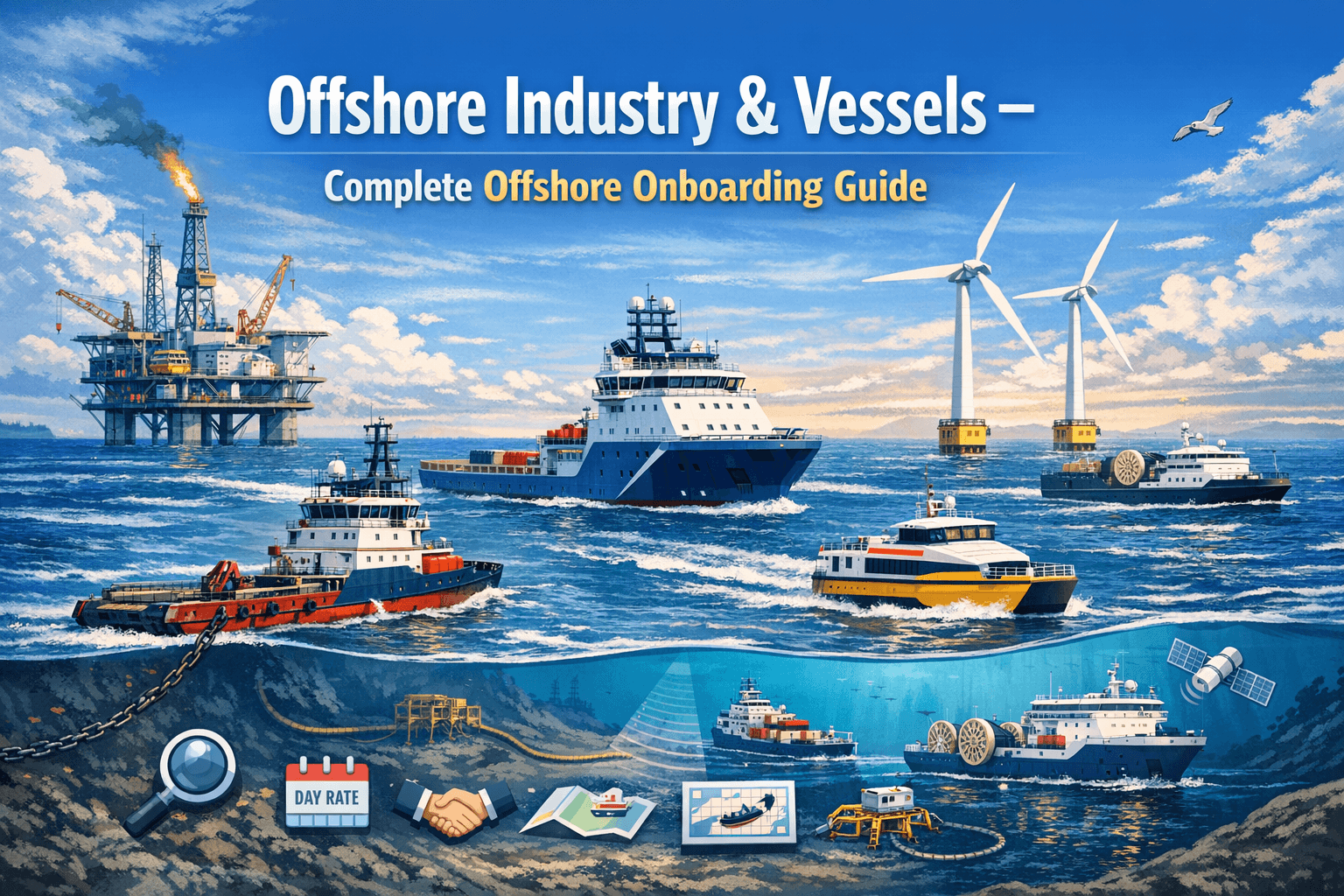
Beginner Level — Offshore Industry Explained Simply
What the offshore industry is
The offshore industry refers to all industrial activities that happen at sea or under the sea, away from the coast.
Instead of building infrastructure on land, companies build and operate energy and marine infrastructure in the ocean.
These activities include:
Offshore wind farms
Oil and gas platforms
Subsea pipelines
Subsea power cables
Marine construction projects
Ocean research and surveys
Most offshore projects take place inside a country's Exclusive Economic Zone (EEZ) — the maritime area where a nation has the right to explore and use marine resources.
Because offshore sites are located far from land, everything required to operate must be transported and supported by specialized vessels.
Simple analogy
Think of offshore projects as construction sites located in the middle of the ocean.
Unlike land-based construction sites:
There are no roads
There are no warehouses
There are no hotels or offices
Everything needed for the project — workers, equipment, materials, fuel, and tools — must arrive by ship.
This is why offshore vessels are essential to the entire offshore industry.
What offshore companies actually do
The offshore ecosystem includes several types of companies that work together to deliver projects.
Energy Developers and Operators
These companies own the energy projects and finance them.
Examples include:
Offshore wind farm developers
Oil and gas operators
Energy infrastructure companies
They define the project, choose the location, and hire contractors to build and operate the infrastructure.
Examples of offshore assets:
Oil platforms
Offshore wind turbines
Floating energy platforms
Subsea production systems
Power export cables
Offshore Contractors
Contractors are responsible for building and installing offshore infrastructure.
Their work includes:
Installing offshore wind turbines
Installing subsea pipelines and cables
Marine construction operations
Subsea installation work
Heavy lifting offshore
In many ways, they act as the construction companies of the ocean.
Marine and Subsea Specialists
These companies perform the technical offshore operations required to support energy projects.
Typical activities include:
Seabed surveys
Subsea installation and repair
Offshore logistics
Cable installation
Environmental monitoring
Safety zone monitoring
Shipowners and Vessel Operators
Shipowners own and operate the offshore vessels that make offshore projects possible.
Their responsibilities include:
Operating vessels
Managing crews
Maintaining compliance and safety
Chartering vessels to project operators
Without shipowners and their vessels, offshore projects cannot operate.
Why offshore vessels are essential
Offshore vessels replace the infrastructure normally available on land.
They perform several key roles.
Offshore vessels as transport systems
Offshore vessels act as the trucks of the ocean.
They transport:
Equipment
Spare parts
Construction materials
Fuel and water
Offshore technicians
Food and supplies
Offshore vessels as personnel transport
In offshore wind projects, vessels often act as daily transport for technicians.
They move crews between:
Ports
Offshore wind farms
Offshore platforms
Offshore vessels as floating work platforms
Many vessels function as mobile offshore work platforms.
They may include:
Cranes
Workshops
Subsea deployment systems
Cable installation equipment
Heavy construction tools
These vessels allow complex offshore work to be performed directly at sea.
Offshore vessels as safety assets
Some vessels are deployed purely for offshore safety operations.
These vessels:
Monitor marine traffic
Protect restricted zones
Provide emergency response capability
They are commonly known as guard vessels.
The typical offshore project chain
Understanding how offshore projects are structured is key to understanding the vessel market.
A typical offshore project involves several layers.
Energy Developer or Operator
The company financing and owning the energy project.
Main Offshore Contractor
Responsible for construction or installation.
Marine Subcontractors
Specialized marine companies supporting operations.
Shipowners
Provide offshore vessels.
Chartering Brokers
Often help connect vessel owners and project operators.
Simplified project analogy
You can think of offshore projects as a floating construction chain.
Developer
→ Construction contractor
→ Marine subcontractor
→ Offshore vessels
Offshore vessels are effectively the floating trucks, cranes, and logistics infrastructure required to build projects at sea.
Intermediate Level — Offshore Operations Basics
Main offshore sectors
The offshore industry is divided into several major sectors.
Offshore wind
Offshore wind projects install wind turbines at sea to generate electricity.
Electricity is transported back to land through subsea power cables.
Two types of offshore wind turbines exist.
Fixed offshore wind
Installed on foundations fixed to the seabed
Floating offshore wind
Installed on floating structures anchored to the seabed
Enables projects in deeper water
Offshore wind has become one of the fastest-growing segments of the offshore industry.
Offshore oil and gas
Oil and gas companies drill wells beneath the seabed and extract hydrocarbons.
Production can occur from:
Fixed offshore platforms
Floating production systems
Subsea production systems
These projects require large numbers of offshore vessels for logistics and operations.
Subsea infrastructure
Subsea infrastructure refers to equipment located on or under the seabed.
Typical subsea systems include:
Pipelines
Power cables
Umbilicals
Subsea production systems
In oil and gas, subsea components are often grouped under the acronym SURF:
Subsea Umbilicals
Risers
Flowlines
These systems connect subsea wells to surface facilities.
Marine survey
Before offshore construction begins, companies must understand the seabed and marine conditions.
Survey vessels collect data such as:
Seabed depth (bathymetry)
Soil conditions
Ocean currents
Wave conditions
These surveys ensure offshore infrastructure can be installed safely.
Offshore project phases
Offshore projects typically follow four operational phases.
Survey phase
Goal: reduce uncertainty before construction.
Survey vessels map the seabed and collect environmental data.
This phase determines:
Where infrastructure can be installed
Which equipment will be required
Installation phase
Major components are installed offshore.
Examples include:
Wind turbine foundations
Substations
Pipelines
Subsea cables
This phase requires specialized installation vessels.
Construction phase
Complex offshore construction work is performed.
Typical tasks include:
Heavy lifting
Subsea installation
Structural integration
Construction vessels are often equipped with:
Heavy cranes
ROV systems
Subsea deployment equipment
Operations and maintenance (O&M)
Once the infrastructure is operational, regular maintenance is required.
Typical tasks include:
Equipment inspections
Repairs
Crew transport
Replacement of components
Many offshore wind farms rely heavily on crew transfer vessels during this phase.
Why vessels are critical to offshore operations
Three factors make vessels essential in offshore work.
Offshore logistics
Every piece of equipment must be transported from land to the offshore site.
This makes offshore operations logistics-intensive.
Offshore positioning
Many offshore operations require vessels to hold a precise position near infrastructure.
This is achieved using Dynamic Positioning (DP) systems.
DP systems use thrusters and computer control to maintain position without anchors.
Offshore safety
Offshore energy projects require strict safety monitoring.
Guard vessels are often deployed to:
Monitor shipping traffic
Protect restricted zones
Provide emergency response capability
Offshore Chartering — How vessels are hired
What chartering means
Chartering is the process of hiring a vessel for a specific job or time period.
The agreement is formalized through a charterparty contract.
The charterer pays the shipowner for the use of the vessel.
The three main players
Charterer
The company needing the vessel.
Examples include:
Energy companies
Offshore contractors
Marine service companies
Shipowner
The company that owns and operates the vessel.
They provide:
The vessel
The crew
Operational management
Broker
A broker often acts as an intermediary between the charterer and the shipowner.
Brokers help negotiate the commercial agreement.
Typical chartering process
A typical offshore chartering process includes:
Vessel inquiry
Vessel offers
Negotiations
Agreement recap
Charterparty signature
Most negotiations historically happen via emails, phone calls, and broker networks.
Key information required in a vessel request
When requesting a vessel, the following information is usually required.
Location
Country
Offshore region
Closest port
Distance offshore
Schedule
Start date
Duration
Weather window
Scope of work
Supply operations
Guard vessel duties
Survey work
Subsea operations
Construction support
Technical constraints
Dynamic positioning requirement
Deck space
Equipment
Accommodation capacity
Draft restrictions
Client requirements
Safety standards
Certification requirements
Inspection procedures
Advanced Level — Offshore Vessel Types
AHTS — Anchor Handling Tug Supply Vessels
These vessels are designed to:
Tow offshore rigs
Handle mooring anchors
Support offshore logistics
They are widely used in oil and gas operations.
A key performance metric is bollard pull, which measures towing power.
PSV — Platform Supply Vessels
PSVs provide logistics support for offshore installations.
They transport:
Cargo
Equipment
Fuel
Water
They typically feature large open cargo decks and multiple cargo tanks.
CTV — Crew Transfer Vessels
Crew Transfer Vessels are widely used in offshore wind.
They transport technicians between ports and offshore wind turbines.
They operate primarily in daily shuttle operations.
Guard vessels
Guard vessels protect offshore installations and restricted zones.
Their tasks include:
Monitoring vessel traffic
Maintaining safety distances
Providing emergency standby capability
They are widely used in offshore wind farms.
Survey vessels
Survey vessels collect seabed and oceanographic data.
Typical surveys include:
Bathymetry
Geological surveys
Environmental monitoring
Survey data is essential before any offshore construction.
Multicats
Multicats are versatile offshore workboats used for:
Towing
Anchor handling
Crane operations
Shallow-water marine construction
They are often used in coastal and offshore wind projects.
Cable vessels
Cable vessels install subsea cables on the seabed.
They are essential for:
Offshore wind power export cables
Telecommunications cables
Subsea infrastructure repair
Offshore construction vessels
Construction vessels perform complex offshore installation tasks.
They may include equipment such as:
Active heave compensated cranes
A-frames
Moonpools
ROV deployment systems
These vessels support subsea installation and offshore construction operations.
Key Offshore Industry Terms
Day rate
The daily price paid to hire a vessel.
Example:
“What is the day rate for this PSV for a 30-day project?”
Spot charter
Short-term vessel chartering, often for a single project or short campaign.
Long-term charter
A vessel charter lasting months or years.
Often used for ongoing offshore operations.
Dynamic Positioning (DP)
A system that automatically keeps a vessel in position using thrusters.
DP is essential for many offshore operations near infrastructure.
AIS — Automatic Identification System
AIS is a maritime tracking system used by vessels worldwide.
It broadcasts information such as:
Vessel identity
Position
Speed
Course
AIS data is widely used for vessel tracking and maritime monitoring.
The Offshore Vessel Market Today
Historically, vessel sourcing has relied heavily on:
Email exchanges
Broker networks
Position lists
Informal information sharing
This creates several inefficiencies.
Fragmented information
Vessel availability and technical data are often spread across:
Emails
Spreadsheets
Broker lists
Individual contacts
Slow sourcing process
Finding the right vessel can take significant time due to fragmented data and limited transparency.
Limited market visibility
Charterers often struggle to understand:
Which vessels are available
Where vessels are located
What technical capabilities vessels have
The Future of Offshore Vessel Discovery
The offshore industry is gradually adopting digital platforms that improve:
Vessel discovery
Market transparency
Operational efficiency
Modern offshore tools aim to:
Centralize vessel data
Standardize technical specifications
Improve visibility across the offshore vessel market
These innovations help offshore companies identify vessels faster, compare options more effectively, and reduce the time required to secure offshore assets.
At the intersection of offshore vessel intelligence, digital chartering workflows, and global vessel visibility, new platforms are emerging to modernize how offshore companies discover and source vessels.