
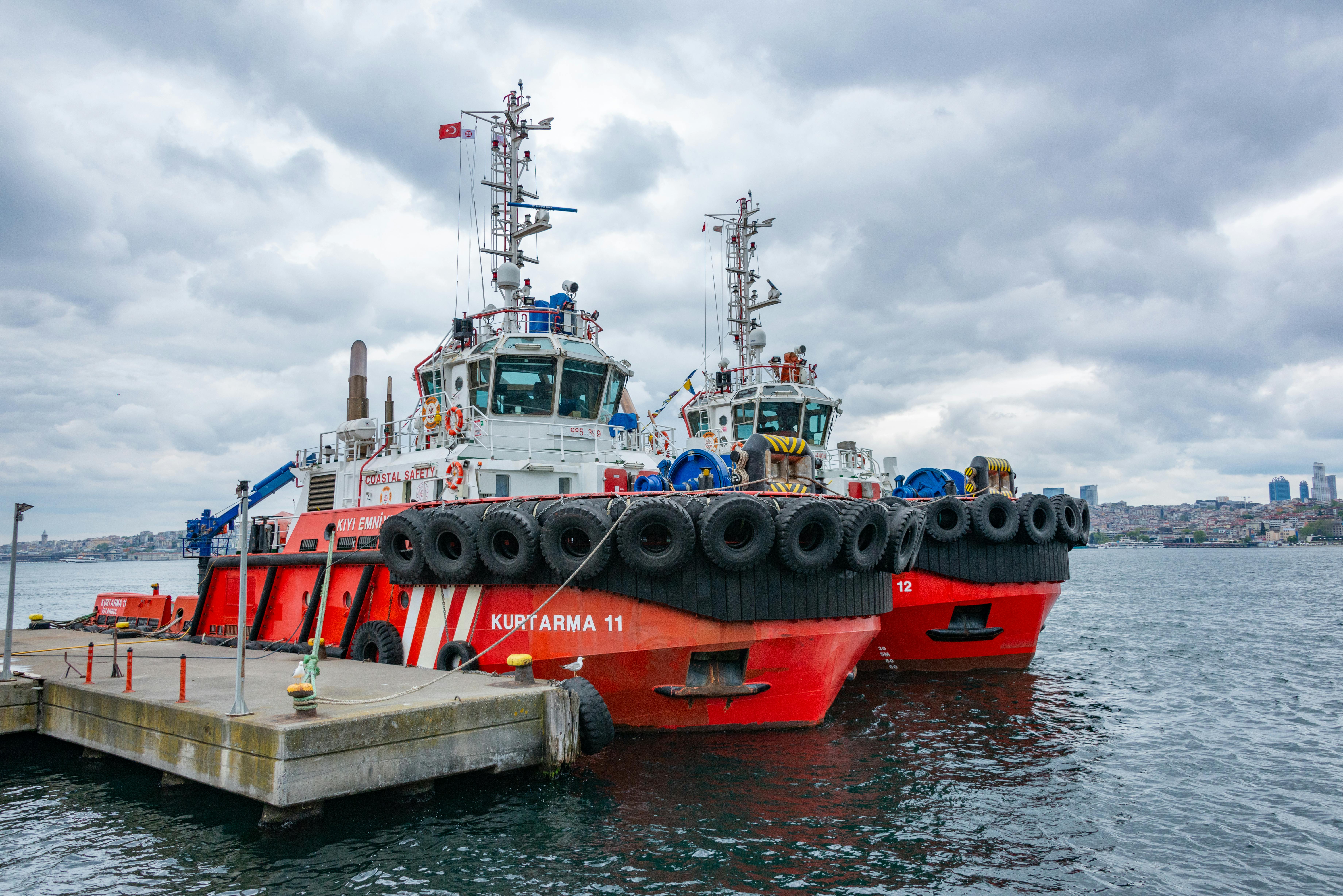
When you search for a tug — for harbor assist, offshore towing, terminal escort, or nearshore construction support — the propulsion type is one of the most operationally decisive specifications on the sheet. It determines maneuverability in confined waters, bollard pull efficiency under load, response time under tow, and suitability for indirect towing in high-current or high-wind environments.
Yet in most vessel databases and chartering platforms, propulsion data is either missing, inconsistently labeled, or buried in classification society PDFs written in notation shorthand that requires specialist knowledge to decode.
This guide covers every major propulsion type found in the global tug fleet — explained from first principles, with the operational logic, the detection signals from class notations and registry data, and the geographic distribution of each type.
Table of contents
Why propulsion type is a chartering decision, not a footnote
ASD — Azimuth Stern Drive
Tractor VSP — Voith Schneider Propeller
Tractor AZ — Azimuth Tractor
Twin Screw Conventional
Single Screw Conventional
CPP — Controllable Pitch Propeller
Kort Nozzle — additive attribute, not a propulsion type
Rotor Tug
Quick reference: class notation signals by society
1. Why propulsion type is a chartering decision, not a footnote
A tug's propulsion system determines its thrust vectoring capability: the ability to generate and direct force independently of the hull's heading. In port, that means the difference between a tug that can hold a precise push vector regardless of current, and one that needs to reposition its hull to change the force direction. In offshore towing, it determines whether sustained bollard pull can be maintained efficiently through sea states. In escort duty, it determines whether the tug can brake or redirect a loaded tanker under emergency conditions.
Three practical questions are answered directly by knowing propulsion type:
Can this tug apply force in any direction without repositioning? — answered by azimuth thruster type and count
Is it suited for indirect towing at speed? — answered by tractor vs. ASD configuration
Can it sustain high bollard pull over long distances efficiently? — answered by CPP and Kort Nozzle presence
These are not specifications to verify after contract. They should drive the initial filter.
2. ASD — Azimuth Stern Drive
The dominant propulsion type in the modern ocean-going and harbor tug fleet worldwide. An ASD tug has two azimuth thrusters mounted at the stern, each capable of rotating through a full 360° arc, allowing the generation of thrust in any horizontal direction without the hull needing to move.
This gives ASD tugs exceptional maneuverability: they can turn on their own axis, crab sideways, push forward while pulling the stern, or apply complex compound force vectors — all while stationary or at slow speed. In ship-assist operations, this translates to precise, responsive control during berthing and unberthing in confined dock environments.
Where ASD excels: harbor assist, offshore anchor handling support, AHTS operations, port approach escort where rapid force direction changes are frequent.
Where ASD is less preferred than tractor configurations: indirect towing at higher speeds, where the ASD's stern-mounted thrusters create a girding risk — a failure mode where the towline, under high load, pulls the stern around and risks capsizing the tug. Tractor-type vessels (VSP and AZ) are inherently more resistant to this failure mode.
Detecting ASD in vessel data
Engine / propeller record keywords:
RUDDER PROPELLERAZIMUTH THRUSTERZ-DRIVESCHOTTELAZIMUTH STERN DRIVEAZI
Class notation signals by society:
Society | Typical notation |
|---|---|
Bureau Veritas (BV) | TUG, with ASD or AZ in propulsion remarks |
DNV | Tug, notation ASD or Azimuth Stern Drive |
Lloyd's Register (LR) | Tug (ASD) |
ABS | Tug + ASD in propulsion remarks |
ClassNK | Tug (ASD) or Z-PELLER |
RINA | Tug ASD |
RMRS (Russian) | Буксир АСД |
Geographic concentration: Global — North Sea, Mediterranean, Asia-Pacific, Gulf of Mexico, West Africa
3. Tractor VSP — Voith Schneider Propeller
The Voith Schneider Propeller (VSP) is a cycloidal propulsion system: a rotating disc mounted forward under the hull, carrying a series of vertical blades that can each be pitched independently while the disc spins. The combined effect of blade pitching on a rotating disc allows thrust to be generated in any horizontal direction — and more importantly, to be continuously and instantaneously varied in both magnitude and direction.
There is no separate rudder. There is no lag from engine reversing. The VSP system produces thrust vector changes faster than any other marine propulsion system currently in commercial service.
VSP tugs are classified as tractor tugs because the propulsion units are located forward under the hull, with the towline connection at the stern. This means thrust and load are on the same end of the vessel, eliminating the girding vulnerability that affects ASD tugs in indirect towing.
Where VSP excels: harbor assist in constrained or high-traffic ports, emergency response towing, any operation where instant force reversal or precise low-speed control is paramount. VSP tugs are considered the gold standard for harbor assist work where speed of response matters most.
Where VSP is less preferred: high-speed offshore towing. The cycloidal system is optimized for the speed range of port approaches (2–6 knots) and loses efficiency at higher towing speeds. Maintenance is also more complex and expensive than propeller-based systems.
Detecting VSP in vessel data
Engine / propeller record keywords:
VOITH SCHNEIDERVSPCYCLOIDAL PROPELLERVOITH
Class notation signals by society:
Society | Typical notation |
|---|---|
BV | VSP or VOITH in propulsion remarks |
DNV | Tug (VSP) or Voith Schneider Tractor |
LR | Tug (Voith Schneider) |
ABS | Voith Schneider in propulsion remarks |
ClassNK | Tug (VSP) |
RINA | Tug VSP |
Geographic concentration: Northern Europe — Rotterdam, Hamburg, Bremerhaven, Antwerp, Gothenburg. Significant presence also in Canada and Japan.
4. Tractor AZ — Azimuth Tractor
An azimuth tractor uses azimuth thrusters as its propulsion mechanism — identical in technology to ASD — but places them forward under the hull rather than at the stern. As with VSP tractors, the working deck and towline connection point are at the stern, providing the same inherent resistance to girding as the VSP configuration.
The operational performance of an azimuth tractor sits between ASD and VSP: more stable than ASD under high indirect towing loads, but with faster response and higher efficiency at towing speeds than a VSP. The azimuth tractor is the preferred configuration for high-speed escort towing operations in large port approaches.
The critical detection problem: AZ Tractor vs. ASD
This is the most significant classification error in automated vessel data systems. Both ASD and Tractor AZ use azimuth thrusters. Both will produce identical keywords (AZIMUTH THRUSTER, Z-DRIVE, SCHOTTEL) in engine propeller records. The only reliable differentiating signals are:
Propeller position notation:
AZIMUTH THRUSTER FWDorAZIMUTH TRACTORin propeller records is an unambiguous positive signal for tractor configuration.Class notation language:
TRACTOR TUG,TUG AZ FWD, orTractorin class certificate text.
In the absence of either signal, a vessel showing only generic azimuth keywords must be treated as ambiguous — and should not be confidently classified as either ASD or Tractor AZ without manual review of the original class document.
Detecting Tractor AZ in vessel data
Engine / propeller record keywords:
AZIMUTH THRUSTER FWDAZIMUTH TRACTORTRACTOR AZ
Class notation signals by society:
Society | Typical notation |
|---|---|
BV | TRACTOR TUG or TUG AZ FWD |
DNV | Tug (Tractor) with azimuth forward notation |
LR | Tractor Tug |
ABS | Tractor Tug |
5. Twin Screw Conventional
Two fixed-pitch propellers on separate shafts, each with its own conventional rudder. The twin configuration provides redundancy and meaningfully improved maneuverability over single-screw designs: by applying differential throttle — one shaft ahead, one astern — the vessel can pivot without relying purely on rudder effect, and can maintain steerage at low speed.
Twin screw conventional tugs are the workhorses of the mid-range fleet. They lack the all-azimuth thrust of ASD or VSP, but offer proven reliability, simpler drivetrain maintenance, and lower capital cost. They are common in port authority fleets operating older vessels, in river and inland waterway towing, and in cost-sensitive markets across West Africa, Southeast Asia, and the Middle East.
Where twin screw conventional is appropriate: barge towing, harbor dredge support, coastal towing, pusher duties, port operations where the confined-water precision of azimuth systems is not required.
Detecting Twin Screw Conventional in vessel data
Engine / propeller record keywords:
TWIN SCREW2 SCREW PROPELLER2 FPFIXED PITCH TWIN
Class notation signals:
Society | Typical notation |
|---|---|
BV | TUG, TWIN SCREW |
DNV | Twin Screw |
Most others | Not explicitly notated beyond screw count |
6. Single Screw Conventional
The simplest and oldest configuration: one fixed-pitch propeller on a centerline shaft, with a single conventional rudder. Thrust reversal requires reversing the engine or engaging a reversing gearbox. Maneuverability is limited — turning radius is wide and directional control at low speed depends on propeller wash over the rudder.
Mechanical simplicity is the overriding advantage. A single screw conventional tug has fewer components, simpler maintenance requirements, and lower capital cost than any other configuration. It remains highly relevant for river towing, inland pusher operations, and coastal towing assignments where forward-bias operations dominate and confined-water agility is not the primary requirement.
In offshore chartering, single screw conventional is rarely specified for complex operations, but remains the right vessel for straightforward coastal towing, barge movements in open water, and anchor deployment in unconstrained environments.
Detecting Single Screw Conventional in vessel data
Engine / propeller record keywords:
SINGLE SCREW1 SCREW PROPELLER1 FPFIXED PITCH
Single screw is often identified by exclusion in automated classification: absence of twin-screw, azimuth, or VSP signals, combined with a single-shaft indicator. This makes automated confidence scores lower for this type than for more distinctively-notated configurations.
7. CPP — Controllable Pitch Propeller
CPP is a propeller mechanism, not a hull or thrust configuration. The propeller blades are mounted on a hub that allows their pitch angle to be mechanically adjusted while the shaft continues spinning. By changing pitch, the operator changes the magnitude and direction of thrust — from full ahead to full astern — without stopping or reversing the engine.
This matters operationally because it allows the engine to remain at its optimal RPM across the full operating speed range, improving fuel efficiency and providing faster thrust response than a reversing engine can achieve. It is particularly valuable in operations requiring frequent and rapid changes in pull: offshore towing through variable sea states, anchor handling, dynamic positioning support.
CPP can be applied to both single-screw and twin-screw hulls. A vessel should be classified as "Twin Screw CPP" or "Single Screw CPP" — not simply "CPP." CPP is a modifier that overlays the base configuration.
Detecting CPP in vessel data
Engine / propeller record keywords:
CPPCONTROLLABLE PITCHVARIABLE PITCHKA-SERIES CPP
8. Kort Nozzle — additive attribute, not a propulsion type
The Kort Nozzle is a ducted propeller system: a fixed annular nozzle surrounding the propeller disc. It accelerates water flowing through the disc and significantly increases bollard pull efficiency at low speeds — typically a 20–30% improvement in static bollard pull compared to an open propeller of equivalent diameter and power.
The critical classification point: a Kort Nozzle does not define a propulsion type. A tug with a Kort Nozzle is still a Twin Screw Conventional, or a Single Screw CPP, or whatever base configuration it carries. The nozzle is an additive attribute that modifies the performance of the base propeller system.
Treating Kort Nozzle as a standalone propulsion type in a vessel database creates a false category that obscures the actual propulsion architecture. A charterer filtering for "Kort Nozzle" tug vessels is really looking for high bollard pull at low speed — information that is only meaningful when combined with the base configuration.
Kort Nozzles are strongly associated with offshore towing operations where sustained bollard pull over long distances is the primary performance criterion. They are rarely found on harbor assist tugs, where the nozzle's performance advantages at low speed are offset by reduced top speed and maneuverability compared to open-propeller designs.
Common Kort Nozzle combinations:
2 SCREW PROPELLER KORT NOZZLE— twin screw conventional with nozzleCPP KORT NOZZLE— controllable pitch with nozzle, common on AHTS
Detection keywords:
KORT NOZZLENOZZLEDUCTED PROPELLER
9. Rotor Tug
The Rotor Tug is a patented concept developed by Robert Allan Ltd, implemented commercially by a small number of specialized operators. It uses three azimuth thrusters in a triangular arrangement — one forward, two aft — rather than the two-thruster layout of a conventional ASD or tractor. This tri-thruster triangle provides a stable polygon of force vectors: the tug can generate and resist pull from any direction simultaneously, with a higher resistance to girding than any two-thruster configuration.
The Rotor Tug is considered technically superior for large-ship escort duty and for operations where extreme stability under maximum load is the primary requirement. The commercial fleet is very small in absolute terms — most operational Rotor Tugs are concentrated at major ports in Northern Europe and Canada — but the design is distinctive enough that detection from vessel data is straightforward.
Detection keywords:
3 AZIMUTH THRUSTERROTOR TUGVessel name prefix
RT(common in Robert Allan commercial naming)
10. Quick reference: class notation signals by society
This table consolidates the classification notation patterns that matter most for automated propulsion type detection across the six major international classification societies.
Propulsion type | BV | DNV | LR | ABS | ClassNK | RINA |
|---|---|---|---|---|---|---|
ASD | TUG + ASD / AZ | Tug, ASD | Tug (ASD) | Tug + ASD remarks | Tug (ASD) / Z-PELLER | Tug ASD |
Tractor VSP | VSP / VOITH | Tug (VSP) / Voith Schneider Tractor | Tug (Voith Schneider) | Voith Schneider remarks | Tug (VSP) | Tug VSP |
Tractor AZ | TRACTOR TUG / TUG AZ FWD | Tug (Tractor) AZ fwd | Tractor Tug | Tractor Tug | — | — |
Twin Screw Conv. | TUG, TWIN SCREW | Twin Screw | Tug | Tug | Tug | Tug |
CPP | CPP in remarks | CPP noted | CPP noted | CPP noted | CPP noted | CPP noted |
Rotor Tug | — | — | — | — | — | — |
Note: Single Screw Conventional is rarely notated explicitly by any society. It is typically identified by exclusion — absence of twin-screw, azimuth, or VSP signals — combined with single-shaft indicators in propeller records.
Propulsion type and operational fit: a summary
Propulsion type | Harbor assist | Offshore towing | Escort duty | Inland / coastal | Bollard pull focus |
|---|---|---|---|---|---|
ASD | ✓✓ | ✓ | ✓ | – | – |
Tractor VSP | ✓✓✓ | – | ✓✓ | – | – |
Tractor AZ | ✓✓ | ✓ | ✓✓✓ | – | – |
Twin Screw Conv. | ✓ | ✓ | – | ✓✓ | ✓ |
Single Screw Conv. | – | ✓ | – | ✓✓✓ | – |
CPP (modifier) | – | ✓✓ | – | ✓ | ✓✓ |
+ Kort Nozzle | – | ✓✓✓ | – | ✓ | ✓✓✓ |
Rotor Tug | ✓✓ | – | ✓✓✓ | – | – |
Propulsion data quality in offshore vessel databases
Across most major vessel databases and public registries, propulsion type is one of the highest-frequency missing or inconsistently labeled fields for tugs. The structural reasons are well understood: class notation conventions differ meaningfully across societies, propeller record terminology is unstandardized, and the distinction between ASD and Tractor AZ requires position context that is rarely captured in structured data fields.
At Seavium, we work specifically on this problem — using AI to parse class certificate data, cross-reference engine registration records, and produce a normalized, confidence-scored propulsion type for each tug vessel across our dataset. Low-confidence matches are flagged for manual expert review. Every propulsion label carries a source tag (structured data, OCR, or manual correction) so users know the basis of the classification.
If you're working on a tug requirement and propulsion type is a decision factor, we're happy to help narrow the field.
→ Explore tug vessels by propulsion type: go.seavium.com → Specific requirement or question: sales@seavium.com
Seavium is a maritime AI platform for offshore vessel chartering and market intelligence, covering 30,000+ vessels across 200+ companies in 25+ countries.