
Introduction
In offshore chartering, technical specifications are only half the story.
A vessel can be technically perfect — and still be a poor choice if it is poorly positioned.
That’s why geography is one of the most critical, and often underestimated, dimensions of vessel selection.
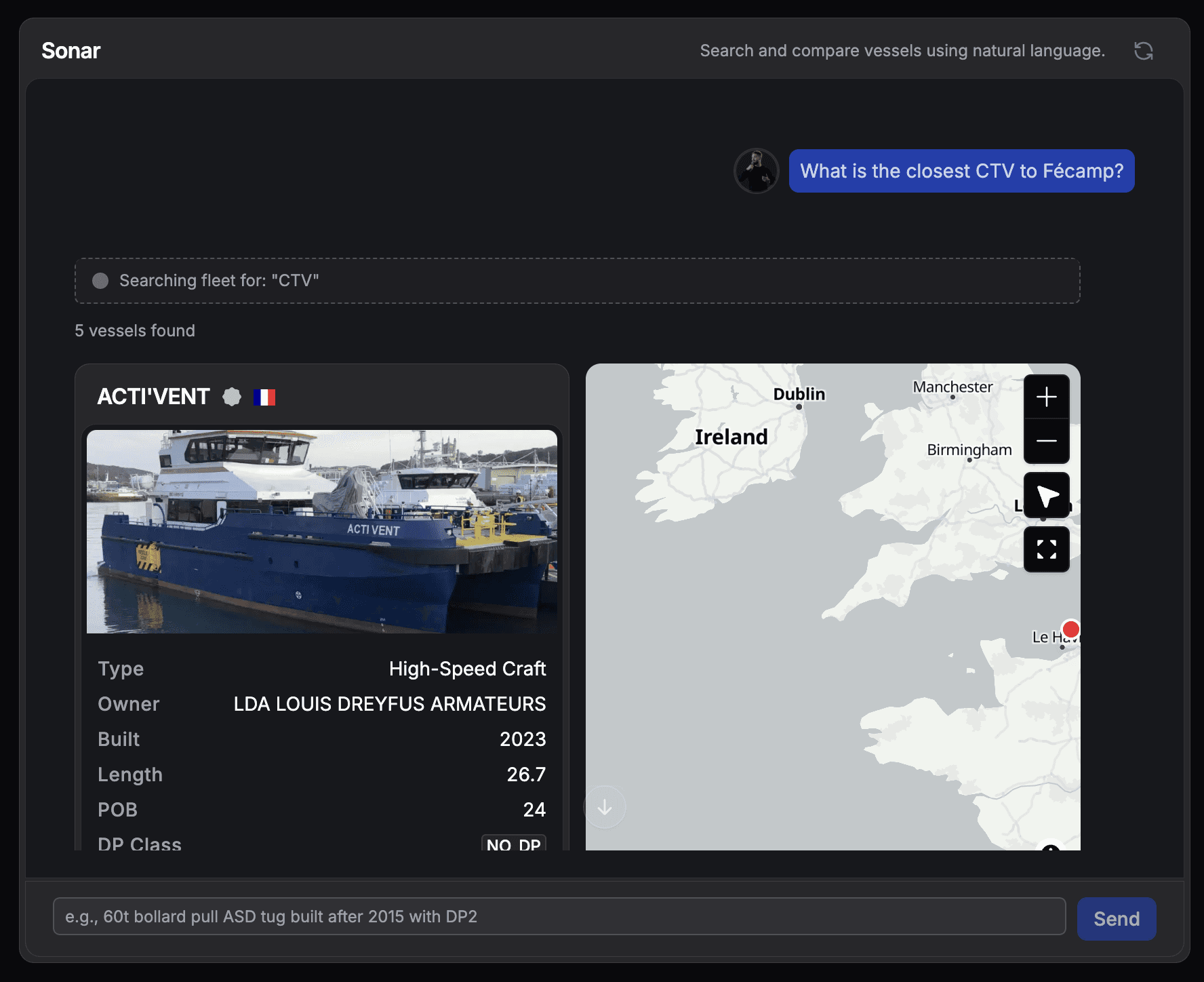
This week, Seavium deployed the first version (V0) of geographical reasoning in Sonar.
From static search to geographic awareness
Traditional vessel search tools treat location as a secondary filter.
Sonar takes a different approach.
Even in its initial version, Sonar now:
interprets geographic constraints expressed in natural language,
links vessel positions to operational feasibility,
and integrates location directly into the ranking logic.
This allows Sonar to reason beyond static compatibility.
What Sonar V0 can already do
With this first geographical layer, Sonar can:
understand zones, regions, and countries,
combine proximity with technical constraints,
reduce irrelevant results caused by unrealistic transit distances.
This immediately improves the relevance of search results in real offshore scenarios.
Why this is only the beginning
This is a V0 by design.
Geographical reasoning is a foundational capability that enables:
transit and mobilization logic,
cost and delay awareness,
deeper operational feasibility checks.
Future iterations will expand on this base.
Built for offshore reality
Offshore operations are location-driven:
weather windows,
distance to site,
port availability,
regional regulations.
Embedding geography into Sonar is a necessary step toward AI that understands offshore work as it actually happens.
Conclusion
Technical compatibility alone is not enough.
By introducing geographical reasoning into Sonar, Seavium takes a clear step toward more operationally realistic vessel selection.
This is V0 — but it is a decisive foundation.
👉 Explore Sonar: https://go.seavium.com